
Kickoff: The Rush, the Risks, and the Big Ask
Picture your busiest hour on the dock. Orders spike, aisles tighten, and human focus stretches thin. The pallet stacker sits like a sprinter in the blocks, waiting for the gun. Numbers don’t lie: most slowdowns trace back to handoffs, blind turns, and empty travel loops. Some studies peg corner incidents and misreads at over 20% of all close calls—funny how that works, right? So here’s the real question: can you hit speed and stay safe, without trading one for the other? I’m telling you—yes. But it takes intent, clear rules, and the right mix of machine and method (not just more muscle). We’ll dive into what makes the floor safer, what gets in the way, and how to read the signals before they break your flow. Ready to train smarter, not harder? Let’s move.
Beyond Part 1: The Hidden Friction You Can’t See—Until You Can
Where do the old fixes fail?
In Part 1, we talked about basic safety habits and clear traffic rules. Now let’s go a layer deeper and get technical. The shift to an automated pallet stacker helps most where manual work hits invisible drag. Look, it’s simpler than you think. Human operators fight micro-delays at corners, inconsistent load height, and battery dips that show up as late-cycle strain. Without LiDAR coverage and reliable SLAM maps, those blind zones don’t announce themselves. Hand signals and mirror checks help, but they don’t scale when three aisles converge. And that’s before we talk about data gaps—no timestamps, no path heatmaps, no way to tune routes.

Legacy stopgaps also hide ergonomic pain. Long shifts build fatigue, and fatigue builds error. A manual cart might skate through once, then stumble the next hour. Torque spikes feel small but add up in tight turns. PLC logic without modern geofencing can’t adapt to pop-up obstacles. And if your WMS can’t speak cleanly to edge computing nodes, you lose the chance to reroute on the fly. The result is choppy motion, jittery queues, and too many “almosts.” Power converters, charge windows, and uneven floors only amplify the noise. The right fix reduces noise at the source, not after the incident report.
Comparative Lens: New Rules, Real Gains
What’s Next
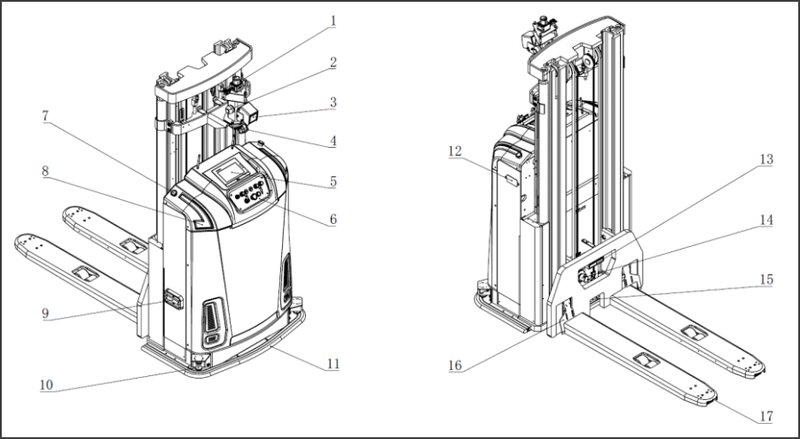
Here’s the forward look. Today’s automated pallet stacker relies on a tight loop: LiDAR plus depth cameras for perception, SLAM for live maps, and geofencing to define “safe by design.” Edge computing nodes process paths in milliseconds; the WMS feeds priorities; the PLC enforces stops with deterministic timing. Instead of “do your best,” the machine runs to a spec. Compare that to a manual stacker: one tool, many behaviors. Now, every curve gets a known radius, every load shift a torque envelope, every aisle a speed cap tied to visibility. A mid-size 3PL that switched two aisles to autonomous moves saw near-misses drop by a third, and empty travel cut by double digits—and nobody misses the old battery charts. The stacker became a metronome. People focused on exceptions, not babysitting.
Let’s keep it practical and advisory. If you’re weighing options, track three metrics. First, safety integrity in mixed traffic: does the system prove its stops and yields under crowding, not just in demos? Second, utilization under load variance: can it maintain line speed with odd pallets, varied heights, and weekend staffing? Third, integration latency: how fast do WMS updates change the path, and can the stacker recover from map drift without a reboot? Summing up, we learned that consistency beats heroics, data beats hunches, and speed follows from control—not the other way around. Choose the system that reduces noise at the source and makes smart the default. When in doubt, benchmark on your floor, with your loads, and your blind corners. For a deeper technical view grounded in real deployments, see SEER Robotics.